Basic Lake Erie Facts
About Lake Erie
Lake Erie derives its name from the Erie people, an Indigenous Iroquoian-speaking group that inhabited its southern shoreline. In their language, “Eriehronon” or “Erielhonan” translates to “long tail,” a term linked to wildcats or cougars in the region.
Early French explorers initially associated this meaning with felines, naming the lake Lac du Chat before eventually adopting Lac Érié. By the mid-1700s, the name Erie had firmly taken hold on maps.
The lake has a complex history. Before Europeans arrived, the Erie people lived along the southern shore while Haudenosaunee nations operated more broadly across the area. The Beaver Wars of the 1600s led to the dispersal or absorption of the Erie people by competing nations. European exploration came later—Lake Erie proved to be the final of the Great Lakes to be mapped, as Haudenosaunee resistance along the Niagara River blocked French advance. French explorer Louis Jolliet became the first documented European to reach the lake in 1669.
Settlement along the northern shore was promoted by British authorities in Upper Canada, notably through Colonel Thomas Talbot’s work beginning around 1809, as they sought to counter American expansion. The War of 1812 saw the Battle of Lake Erie in 1813, where American forces under Oliver Hazard Perry secured a crucial naval victory.
In the modern era, waterways like the Erie Canal and the later Welland Canal, which connects to the St. Lawrence Seaway, transformed the lake into a vital shipping and trade artery. Today, Lake Erie stands as the shallowest and warmest of the Great Lakes, supporting commercial fisheries, tourism, and agriculture while facing ongoing environmental management challenges.
Lake Erie contains 50 % of the fish in the great lakes. (Incredible fishing). Addtionally it is warmer than the other great lakes. Makes it ideal to swim.
Key Dimensions & Measurements
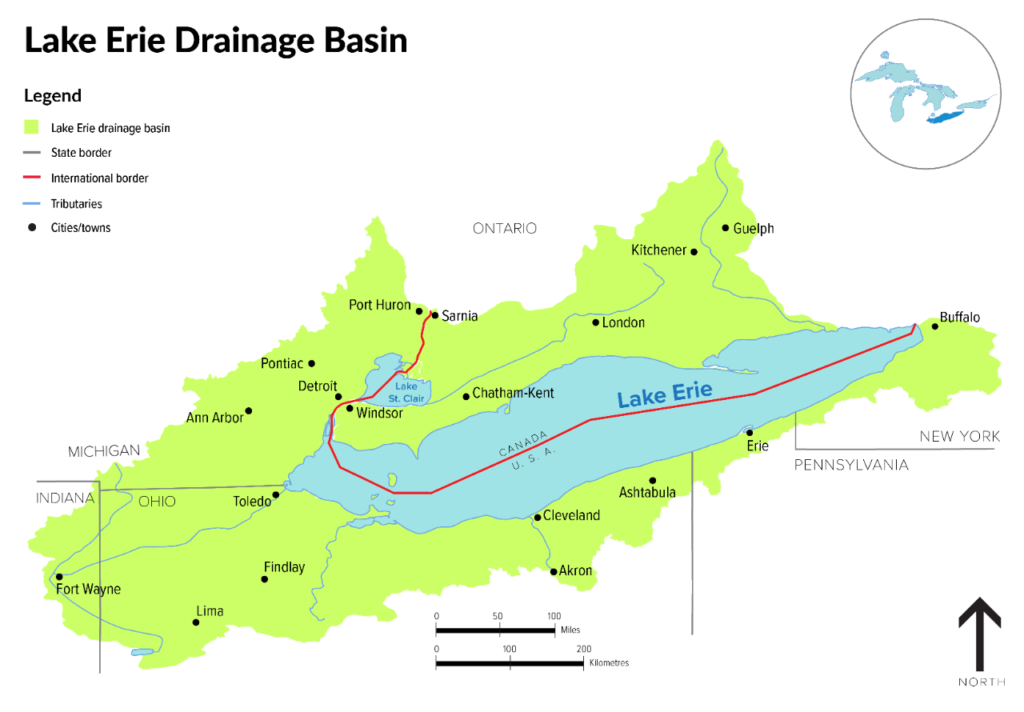
- Length: 241 miles (388 km)
- Maximum Width: 57 miles (92 km)
- Shoreline: 871 miles (1,402 km)
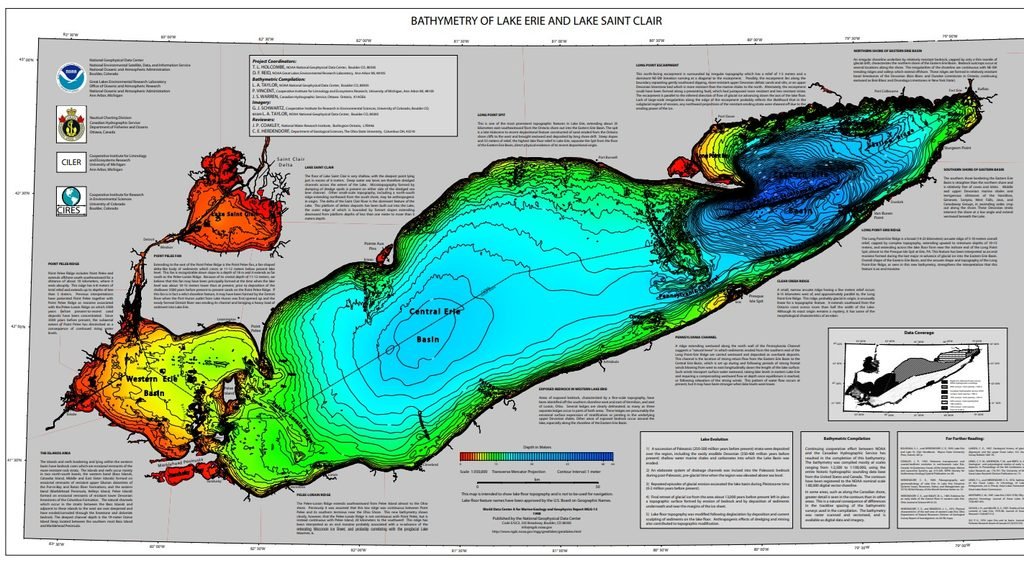
- Average Depth: 62 feet (19 meters)
- Maximum Depth: 210 feet (64 meters)
- Volume: 119 cubic miles (484 cubic kilometers), making it the smallest Great Lake by volume.